Haptic Multiplexer
The Haptic Multiplexer is a tool which allows one to create, save, and send haptic patterns to various haptic devices. This is done by building a Docker container, which exposes an API which talks to a database, which holds haptic patterns.
Code & artifacts
Code lives at on Github on a private repository. This is presently accessible by members of the Muse-IT project. Furthermore, Docker images are presently hosted under thomasve/haptic-multiplexer on Dockerhub, subject to agreement where they must live eventually.
There are two software artefacts to speak of:
- The code itself, which is maintained through commits.
- The Docker images, which are versioned releases of the code which form usable artefacts.
Architecture
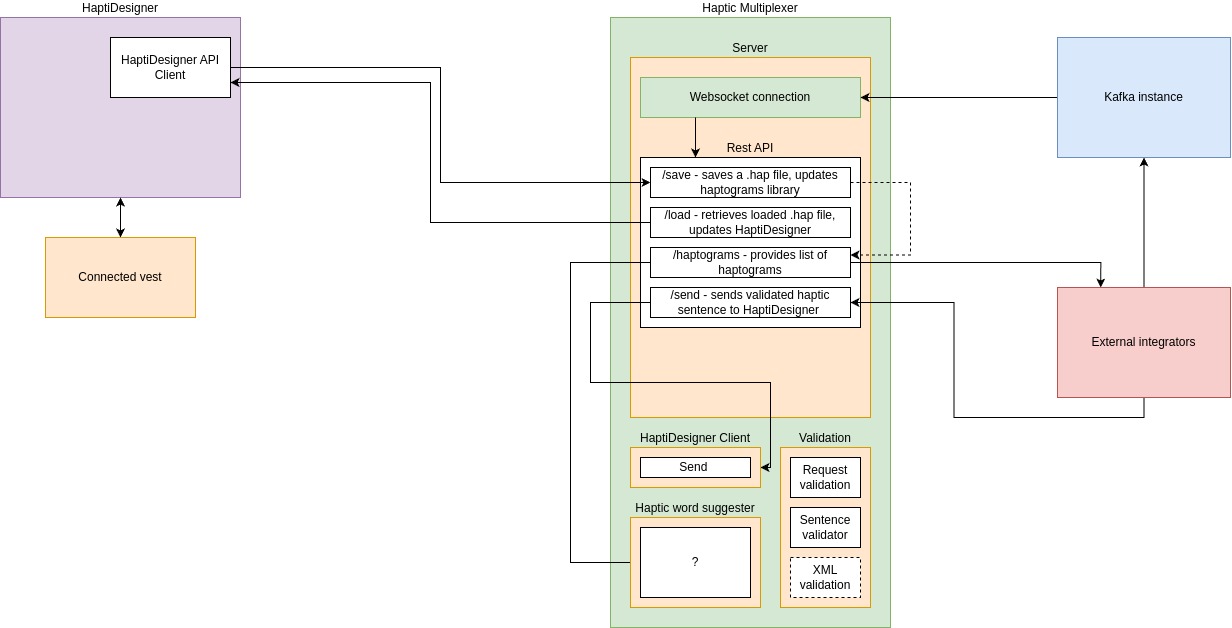
The architecture of the Haptic Multiplexer assumes three componets working in interaction:
- The Multiplexer; this is a FastAPI backend which connects the database with the services. The Multiplexer has a REST API to allow for direct integration, has a Kafka listener to ensure data comes in via the REST API, and a Websocket server which acts as host to the connected haptic devices. This is self-documenting via Swagger when the container is started.
- The database; this is simply a Postgres database to which the Multiplexer can connect.
- HaptiDesigner; this is a frontend which talks to the Haptic Multiplexer, and expose it's API through a webinterface. The webinterface is intended to mimic the HaptiDesigner Desktop version both in function and theme.
Usage & responsibilities
Responsibilities are split as follows:
- The Multiplexer is responsible for:
- Storing/querying data correctly
- Offering a REST API to integrators
- Talking to the connected haptic devices to send haptic sentences
- Managing users and sessions
- Receiving input from the API, or other connected tools
- The database is responsible for:
- Ensuring data integrity
- Handling queries from the Multiplexer
- The Haptic Designer is responsible for:
- Providing a user interface for those wishing to graphically use Haptic Multiplexer
- Hosting QoL features which fall outside the scope of the Multiplexer
Schematic representation
Deployment & development
Environments
Currently, HaptiVerse is hosted at https://multiplexer.haptics.catdad.nl. The Swagger interface, which hosts the documentation, lives at https://multiplexer.haptics.catdad.nl/docs. This is presently the only live environment, pending the arrangement of a production instance.
Local development
To locally use HaptiDesigner, do the following:
- Clone the repo
- Run
docker compose up --build - Navigate to
http://localhost:8000/docs/ - Create a user by making a post to the /users endpoint, and login.
- Upload a .hap file to load haptograms
Production deployment
To host an instance of HaptiDesigner, do the following:
- Build a version with the included Dockerfile
- Move this to a production server.
- (Optional, recommended) Include a DNS address to simplify addressing for your users.
- (Optional, highly recommended!) Include a reverse proxy for SSL termination.
- Visit your instance either directly by IP or by hostname.